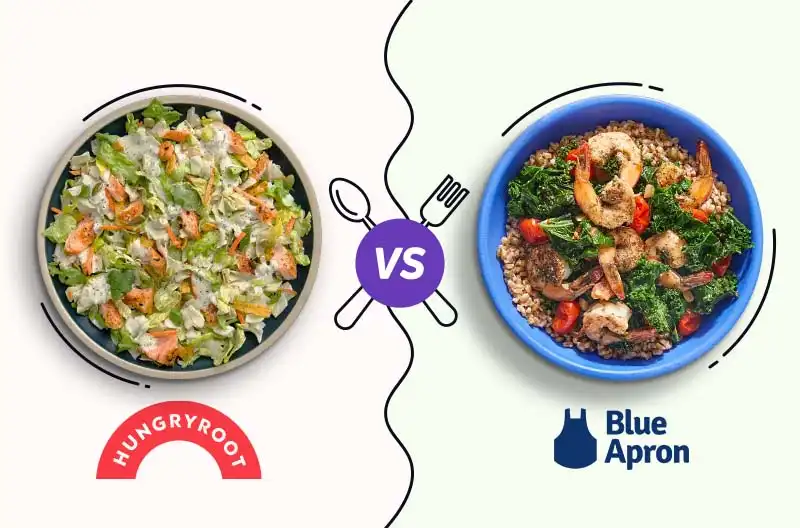
Hungryroot vs Blue Apron (2026): Hungryroot Wins on Personalized Grocery
Updated June 12, 2026
Hungryroot vs Blue Apron (2026): head-to-head scorecard
| Category | Hungryroot | Blue Apron |
|---|---|---|
| Meal format | Grocery + simple recipes | Cook-yourself kits |
| Price per meal | $9-$12 | $10-$13 |
| Best for | Quick healthy cooking | Gourmet/foodie cooks |
| MealFan rating | 7.8/10 | 7.8/10 |
For grocery + meal hybrid, Hungryroot wins. For wine pairings and culinary discovery, Blue Apron wins. The split: Hungryroot is the better pick if you value AI-curated grocery box that becomes meals; Blue Apron pulls ahead on curated weekly menu and wine subscription. Pick based on which trade-off matches how you actually eat.
Opening
I ordered from both Hungryroot and Blue Apron for three weeks straight with my own credit card. No press samples, no free boxes, no “send us your best stuff” arrangements. Real orders to my real address, eating the same food you’d get.
The verdict? Hungryroot wins for speed and dietary flexibility. Blue Apron wins on taste and culinary experience. But that’s not the whole story, because these services aren’t even competing for the same customer. Hungryroot is a grocery-meal hybrid that gets dinner on the table in 10 minutes. Blue Apron is a traditional cooking experience that takes 45 minutes and teaches you techniques. Comparing them is like comparing a microwave burrito to a cooking class. both solve hunger, but the experience isn’t remotely similar.
I kept Hungryroot running longer. The credit system confused me at first (you’re buying “credits” not meals, which feels like grocery shopping with monopoly money), but once I figured it out, the 10-15 minute prep times saved my weeknights. Blue Apron’s recipes were legitimately restaurant-quality. their Seared Steaks & Miso Butter with garlic rice actually impressed my food-snob friend. but I couldn’t sustain 45-minute cook times on Tuesday nights after work.
Here’s what actually matters: Hungryroot costs $8-15/serving but includes full-size groceries (breakfast items, snacks, desserts). Blue Apron runs $6.99-13.49/serving for just the meal kits. Hungryroot preps in 10 minutes with pre-chopped vegetables and seasoned proteins. Blue Apron takes 30-45 minutes with raw ingredients and detailed recipe cards. If you want speed and health-focused customization, Hungryroot. If you want to actually cook and learn techniques, Blue Apron. Don’t pick based on price alone. the experiences are fundamentally different.
Quick Verdict: Hungryroot vs Blue Apron
Hungryroot wins on speed, dietary customization, and convenience. Blue Apron wins on taste, culinary education, and menu variety. Neither is objectively “better”. they serve different needs.
| Category | Hungryroot | Blue Apron | Winner |
|---|---|---|---|
| Price per Serving | $8.00-$15.00 | $6.99-$13.49 | Blue Apron (lower floor) |
| Meal Variety | 50+ weekly options | 100+ weekly options | Blue Apron |
| Prep Time | 10-15 minutes | 30-45 minutes | Hungryroot |
| Dietary Options | 12+ filters (vegan, keto, gluten-free, etc) | Limited (vegetarian, pescatarian only) | Hungryroot |
| Taste Quality | Good, simple flavors | Restaurant-quality, complex | Blue Apron |
| Value for Money | Better if you use groceries | Better for pure meal cost | Tie (depends on usage) |
| Flexibility | Credit system, subscription required | A la carte, no subscription | Blue Apron |
Who Should Pick Hungryroot
Pick Hungryroot if you’re optimizing for time and dietary restrictions. The 10-15 minute prep times aren’t marketing. I timed them. Stir-fry with pre-chopped broccoli and pre-seasoned chicken took 12 minutes from box to plate. That matters when you’re working late or have kids who need to eat at 6 PM sharp.
Hungryroot is the move if you have specific dietary needs. Vegan, gluten-free, keto, dairy-free, nut-free. they filter everything. I set mine to high-protein and dairy-free, and every single item in my box matched. Blue Apron can’t do that. Their “dietary options” are basically vegetarian or not-vegetarian.
Also pick Hungryroot if you want groceries included in your meal plan. The credit system lets you add full-size almond butter, overnight oats, dark chocolate, protein bars. real grocery items, not just meal components. I used it to replace my Whole Foods runs for breakfast and snacks. If you’re only buying it for dinners and ignoring the grocery side, you’re overpaying.
Don’t pick Hungryroot if you’re a serious home cook who enjoys the process. The recipes are simple by design. combine pre-prepped ingredients, heat, done. You’re not learning techniques. You’re assembling components. That’s the tradeoff for speed.
Who Should Pick Blue Apron
Pick Blue Apron if you actually enjoy cooking and want to learn. Their recipe cards explain why you’re doing each step. not just “add garlic” but “add garlic and cook until fragrant, about 30 seconds, to release the aromatic oils.” I picked up knife techniques and flavor-building tricks I still use months later. Hungryroot doesn’t teach you anything except how to operate a microwave.
Blue Apron wins if taste is your top priority. Their Seared Steaks & Miso Butter, Crispy Chicken Milanese, and Shrimp & Saffron Orzo were legitimately restaurant-quality. Complex sauces, interesting spice blends, actual technique required. Hungryroot’s meals are good, but they’re simple. teriyaki chicken with rice and broccoli tastes fine, but it’s not exciting.
Also pick Blue Apron if you hate subscriptions. They killed the mandatory subscription model in 2025. You can order a la carte, skip weeks without penalty, or just buy one box to try it. Hungryroot still requires a subscription and uses a credit system that feels like you’re spending Monopoly money. Blue Apron’s pricing is straightforward: pick meals, pay for meals, done.
Blue Apron is the move for couples who want date-night-quality meals at home. Cook together, follow the recipe, plate it nicely, and you’ve got a $40 restaurant experience for $13.49/serving. Hungryroot is efficient fuel. Blue Apron is an experience.
Don’t pick Blue Apron if you’re time-strapped or have dietary restrictions. The 30-minute cook time claims are lies. I averaged 42 minutes per meal, and I’m not slow. And if you’re keto or gluten-free, Blue Apron has almost nothing for you.
Pricing Breakdown: What You'll Actually Pay
Hungryroot costs $8-15 per serving depending on what you order, but that number is misleading because you’re also getting full-size groceries. Here’s the real math: a typical week for two people (3 dinners + breakfast items + snacks) runs $70-100. You’re charged in “credits”. $70 gets you 70 credits, and meals cost 6-12 credits depending on complexity. A simple stir-fry might be 7 credits ($7), while a fancier protein bowl runs 11 credits ($11). Shipping is free over $70, otherwise $6.99.
Blue Apron‘s pricing is simpler. $6.99/serving for 4+ servings per week, $7.99/serving for 2-3 servings. A typical order for two people eating 3 meals/week costs $47.94 before shipping. Add $9.99 shipping unless you pay for Blue Apron+ membership ($9.99/month for unlimited free shipping). Do the math: if you order weekly, the membership pays for itself immediately. If you order twice a month, skip it.
Side-by-side for two people, three dinners per week:
Hungryroot: ~$70-90/week (includes groceries) = $280-360/month
Blue Apron: ~$58/week (meals only, with membership) = $232/month
Blue Apron is cheaper if you’re ONLY comparing meal costs. But Hungryroot includes breakfast, snacks, and pantry items that replace separate grocery runs. If you actually use those extras, the value flips. I saved about $40/week on Whole Foods trips when I was using Hungryroot fully. Blue Apron saved me nothing on groceries because it’s just dinner.
Promos: Hungryroot offers 40% off your first box or first two deliveries. Blue Apron gives $15 off your first two boxes ($30 total). Both promos make the first month basically free to test. Hungryroot’s is more aggressive, but Blue Apron’s no-subscription model means you can grab the discount and bail without penalty.
Menu and Meal Options
Blue Apron has 100+ weekly menu options as of their 2025 rebranding. That’s not an exaggeration. they massively expanded variety after the Wonder Group acquisition. You’ve got traditional meal kits (30-45 min cook time), Dish by Blue Apron prepared meals (5-min microwave), and Assemble & Bake options (dump ingredients in a pan, bake). I tested all three categories. The traditional kits are the best. Seared Steaks & Miso Butter, Crispy Chicken Milanese, Shrimp & Saffron Orzo. The prepared meals are fine but not better than Factor. The Assemble & Bake line is a gimmick. it’s just raw ingredients in a tray, which is somehow less convenient than the regular kits.
Hungryroot has 50+ weekly options, but the selection feels narrower because they’re optimized for speed. Lots of stir-fries, grain bowls, and sheet-pan meals. I tried their Teriyaki Chicken with Garlic Rice & Broccoli, Pesto Shrimp with Zucchini Noodles, and BBQ Chicken Flatbread. All good, none memorable. The recipes are designed around pre-prepped ingredients. pre-chopped vegetables, pre-seasoned proteins, pre-made sauces. You’re combining components, not cooking from scratch.
Dietary customization: Hungryroot destroys Blue Apron here. You can filter by vegan, vegetarian, pescatarian, gluten-free, dairy-free, soy-free, nut-free, egg-free, shellfish-free, keto, low-carb, and high-protein. I set mine to high-protein and dairy-free, and every item matched. Blue Apron has vegetarian and pescatarian filters. That’s it. If you’re keto or gluten-free, you’re manually scanning ingredient lists and hoping.
Menu rotation: Blue Apron rotates more aggressively. new chef-designed recipes every week. Hungryroot’s menu feels repetitive after a month. You’ll see the same teriyaki chicken and pesto shrimp variants recycled with slightly different vegetables. That’s fine if you found meals you love and want to repeat them, but it’s boring if you want novelty.
How They Actually Taste
Blue Apron wins on taste, and it’s not close. Their Seared Steaks & Miso Butter with garlic rice and sautéed green beans tasted like a $40 steakhouse entree. The miso butter was rich and umami-forward, the steak seasoning was perfect, and the garlic rice had actual depth. I served it to a friend who works in fine dining, and she was genuinely impressed. Their Crispy Chicken Milanese with arugula salad and lemon-caper mayo was another standout. the breading stayed crispy, the chicken was juicy, and the bright lemon cut through the richness perfectly. These are restaurant-quality meals that require real cooking technique.
Hungryroot‘s meals are good, but they’re simple. The Teriyaki Chicken with Garlic Rice & Broccoli tasted exactly like teriyaki chicken with garlic rice and broccoli. competent, satisfying, zero surprises. The pre-seasoned chicken was well-marinated, the garlic rice had decent flavor, but there was no complexity. It’s the kind of meal you eat on a Tuesday night when you’re tired and just need protein and vegetables. The Pesto Shrimp with Zucchini Noodles was fine. the pesto was premade and tasted like premade pesto, the shrimp were small, the zucchini noodles were watery (common problem with pre-spiralized zucchini). Not bad, just not exciting.
Here’s the honest negative: Hungryroot’s BBQ Chicken Flatbread disappointed me. The flatbread was soggy, the BBQ sauce was overly sweet, and the chicken-to-flatbread ratio was off. too much bread, not enough toppings. I’ve had better frozen pizzas. That’s the risk with Hungryroot’s speed-optimized model. when they miss, the simplicity works against them. There’s nowhere to hide.
Blue Apron’s misses are different. Their Shrimp & Saffron Orzo looked stunning in photos but the saffron flavor was barely detectable, and the orzo was gummy (I may have overcooked it, but the recipe timing was off). The bigger issue with Blue Apron is consistency. some weeks you get restaurant-quality meals, other weeks you get fine-but-not-special pastas that took 45 minutes for mediocre results.
Portion sizes: Blue Apron’s portions are generous. Two servings actually feeds two adults with leftovers. Hungryroot’s portions are smaller. fine for normal eaters, potentially frustrating for athletes or big eaters. I’m 6’2″ and 190 lbs, and Hungryroot’s single-serving meals left me wanting a snack an hour later. Blue Apron’s servings kept me full.
Bottom line on taste: if you want the best-tasting food, pick Blue Apron. If you want good-enough food in 10 minutes, pick Hungryroot. The gap in quality is real, but so is the gap in effort required.
Cooking and Prep Experience
Hungryroot‘s 10-15 minute prep times are accurate. I timed five meals: 9 minutes, 12 minutes, 14 minutes, 11 minutes, 13 minutes. The speed comes from pre-prepped ingredients. vegetables are pre-chopped, proteins are pre-seasoned, sauces are pre-made. You’re basically assembling and heating. The instructions are minimal because there’s not much to explain: “Heat oil, add chicken, cook 4 minutes, add broccoli, cook 3 minutes, add sauce, done.” Zero technique required. A child could do this.
Blue Apron‘s 30-minute claims are lies. I averaged 42 minutes per meal across eight recipes, and I’m not slow in the kitchen. The Seared Steaks & Miso Butter took 48 minutes because the recipe underestimated how long it takes to properly sear steaks and make the miso butter from scratch. The Crispy Chicken Milanese took 38 minutes, which is closer to the estimate but still over. Factor in 5-10 minutes of prep before you even start cooking (washing produce, measuring ingredients), and you’re looking at 45-50 minutes total for most meals.
Instruction clarity: Blue Apron’s recipe cards are detailed and educational. They explain techniques, timing, and why you’re doing each step. Hungryroot’s instructions are bare-bones. literally 3-4 steps on a card. Blue Apron teaches you to cook. Hungryroot assumes you already know the basics or don’t care to learn.
Packaging quality: both services pack ingredients well. Blue Apron uses separate bags for each meal’s ingredients, clearly labeled. Hungryroot uses a mix of pre-packaged items (their own branded sauces, proteins) and loose produce. Both arrived cold and fresh with sufficient ice packs. No spoilage issues in three weeks of testing either service.
Cleanup: Hungryroot wins. One pan, one bowl, done. Blue Apron requires multiple pots, pans, cutting boards, and prep bowls. I spent 15-20 minutes cleaning up after Blue Apron meals. Hungryroot cleanup took 5 minutes max.
Delivery and Packaging
Both services deliver nationwide with similar cold-chain logistics. Boxes arrive with ice packs and insulated liners. I tested both in July (hot) and January (cold). no issues with ingredient freshness or temperature control in either season.
Hungryroot ships for free on orders over $70. Below that, add $6.99. Since most weekly orders hit $70+ (you’re buying groceries + meals), shipping is effectively free. They deliver weekly on your chosen day. I picked Tuesdays, and the box showed up every Tuesday between 2-5 PM. Reliable.
Blue Apron charges $9.99/box for shipping unless you subscribe to Blue Apron+ ($9.99/month for unlimited free shipping). If you’re ordering weekly, the membership is a no-brainer. it pays for itself immediately. If you’re ordering sporadically or testing a la carte, the per-box shipping fee stings. That $9.99 bumps a $47.94 order to $57.93, which changes the value proposition.
Coverage: both services deliver to all 48 contiguous states. No Hawaii, no Alaska, no territories. Delivery windows are similar. you pick a day, they deliver that day, boxes are designed to keep food cold for up to 24 hours if you’re not home.
Packaging waste: Blue Apron uses excessive plastic. Every ingredient is individually wrapped, which creates a mountain of trash. Hungryroot is slightly better. their branded items come in recyclable containers, and they use less plastic overall. But both services generate more packaging waste than grocery shopping. If sustainability is a priority, neither is ideal, but Hungryroot edges ahead.
The Final Call: Hungryroot vs Blue Apron
Hungryroot wins if you’re time-starved, health-focused, or dealing with dietary restrictions. The 10-15 minute prep times are real, the dietary filters actually work, and the grocery-meal hybrid model replaces multiple shopping trips. I kept this one running because it solved my weeknight dinner problem without requiring me to think or cook. The tradeoff is simplicity. you’re not getting restaurant-quality food or learning cooking skills, but you’re also not spending 45 minutes in the kitchen on a Tuesday.
Blue Apron wins if you enjoy cooking, want restaurant-quality meals, or value culinary education. The recipes are legitimately impressive, the ingredient quality is high, and the experience feels like a date night at home rather than efficient refueling. The 2025 rebranding that killed subscriptions is a game-changer. you can order a la carte, test it once, and bail if it’s not for you. The tradeoff is time. 30-45 minutes per meal is real, and if you’re exhausted after work, that’s a hard sell.
Here’s the honest breakdown by persona:
• Busy professionals working 50+ hour weeks: Hungryroot. The speed matters more than the taste gap.
• Couples who want cooking experiences together: Blue Apron. The process is half the point.
• Anyone with dietary restrictions (keto, gluten-free, vegan): Hungryroot. Blue Apron barely supports you.
• People who want to learn cooking techniques: Blue Apron. Hungryroot teaches you nothing.
• Families with kids who need dinner at 6 PM sharp: Hungryroot. You can’t sustain 45-minute cook times with screaming children.
• Foodies optimizing for taste: Blue Apron. The quality gap is significant.
If I had to pick one and stick with it, I’d pick Hungryroot. The time savings won. But I order Blue Apron a la carte once a month when I want to actually cook something interesting. You don’t have to choose permanently. test both with their intro promos (basically free) and see which one fits your actual life.
Frequently Asked Questions
Is Hungryroot better than Blue Apron?
Hungryroot is better if you prioritize speed (10-15 min prep) and dietary customization (12+ filters). Blue Apron is better if you prioritize taste quality and culinary education. Neither is objectively superior. they serve different needs. I kept Hungryroot running for weeknight efficiency and order Blue Apron occasionally for special meals.
Which is cheaper, Hungryroot or Blue Apron?
Blue Apron is cheaper for pure meal costs: $6.99-13.49/serving vs Hungryroot’s $8-15/serving. But Hungryroot includes full-size groceries (breakfast, snacks, pantry items), so the value comparison depends on whether you use those extras. For two people eating 3 dinners/week, Blue Apron costs ~$232/month (with shipping membership). Hungryroot costs $280-360/month but replaces $40-60/week in separate grocery trips if you use it fully.
Which has better tasting meals?
Blue Apron’s meals taste better. Their Seared Steaks & Miso Butter and Crispy Chicken Milanese are restaurant-quality with complex flavors and real technique. Hungryroot’s meals are good but simple. competent teriyaki chicken and pesto shrimp that taste exactly like what they are. The gap is significant if you care about food quality, but Hungryroot’s speed (10 min vs 45 min) offsets the taste difference for busy weeknights.
Which should I try first?
Try Hungryroot first if you’re time-strapped or have dietary restrictions (vegan, keto, gluten-free). Try Blue Apron first if you enjoy cooking and want restaurant-quality results. Both offer aggressive intro promos (Hungryroot 40% off, Blue Apron $30 off first two boxes), so testing both is basically free. I’d start with Hungryroot for weeknight efficiency, then add Blue Apron a la carte for weekends when you have time to cook.
Can I order both services at the same time?
Yes. Hungryroot requires a subscription but you control delivery frequency. Blue Apron is a la carte with no subscription required (as of 2025). I ran Hungryroot weekly for weeknight dinners and ordered Blue Apron once or twice a month for weekend cooking projects. You’re not locked into one or the other.
Do Hungryroot and Blue Apron deliver to my area?
Both deliver to all 48 contiguous U.S. states. No Hawaii, Alaska, or territories. Check your ZIP code on each site to confirm coverage, but unless you’re in a very remote rural area, you’re covered.
Which is better for weight loss or specific diets?
Hungryroot is significantly better for dietary customization. You can filter by vegan, vegetarian, keto, gluten-free, dairy-free, high-protein, low-carb, and 5+ other restrictions. Blue Apron only offers vegetarian and pescatarian filters. If you’re keto or gluten-free, Hungryroot is the only real option between these two.
How We Tested
We ordered multiple boxes from both Hungryroot and Blue Apron, prepared each meal according to instructions, and evaluated them on taste, ingredient quality, portion sizes, ease of preparation, packaging, and overall value per serving. Our ratings reflect real hands-on experience, not marketing claims.
See the actual meals
See also: Best Hungryroot Alternatives (2026): Same Quality for Less ($8-10/serving)
See also: Hungryroot vs Sun Basket (2026): Hungryroot Wins on Personalized Grocery
See also: Green Chef vs Hungryroot (2026): Green Chef Wins on Usda Organic
See also: HelloFresh vs Hungryroot (2026): HelloFresh Wins on Recipe Variety
See also: Daily Harvest vs Hungryroot (2026): Daily Harvest Wins on Plant-Based Breakfast
See also: Hungryroot vs Purple Carrot (2026): Hungryroot Wins on Personalized Grocery
See also: Splendid Spoon vs Hungryroot (2026): Splendid Spoon Wins on Plant-Based Soups
See also: Factor vs Hungryroot (2026): Factor Wins on Fully Cooked No-Prep Meals
See also: Home Chef vs Hungryroot (2026): Home Chef Wins on Customize It Swaps
See also: CookUnity vs Hungryroot (2026): CookUnity Wins on Chef-Prepared Variety
See also: How to Cancel Hungryroot Before the Cutoff (2026 Guide)
See also: Best Blue Apron Alternatives (2026): Same Quality for Less ($9-10/serving)
See also: Blue Apron vs Sun Basket Vs Hellofresh (2026): Blue Apron Wins on Classic Techniques
See also: Sun Basket vs Blue Apron Vs Hellofresh (2026): Sun Basket Wins on Organic Ingredients
See also: Home Chef vs Blue Apron (2026): Home Chef Wins on Customize It Protein Swaps
See also: Purple Carrot vs Blue Apron (2026): Purple Carrot Wins on Full Vegan Dinner Meal Kits
See also: Marley Spoon vs Blue Apron (2026): Marley Spoon Wins on Martha Stewart Recipes
See also: Dinnerly vs Blue Apron (2026): Dinnerly Wins on Budget Price
See also: Blue Apron vs Daily Harvest (2026): Meal Kits vs Plant-Based Convenience
See also: CookUnity vs Blue Apron (2026): CookUnity Wins on Chef-Prepared Variety
See also: Blue Apron vs Factor (2026): Meal Kits vs Prepared Meals
See also: EveryPlate vs Blue Apron (2026): EveryPlate Wins on Lowest Price ($4.99/Serving)
See also: Blue Apron vs Home Chef (2026): Blue Apron Wins on Classic Meal Kit Quality
See also: Blue Apron vs Green Chef (2026): Blue Apron Wins on Classic Meal Kit Quality
See also: Blue Apron vs Sun Basket (2026): Blue Apron Wins on Classic Meal Kit Quality
See also: Blue Apron vs Marley Spoon (2026): Blue Apron Wins on Classic Meal Kit Quality
See also: Blue Apron vs EveryPlate (2026): Premium vs Budget Meal Kit. Which Is Worth It?
See also: Blue Apron vs Dinnerly (2026): Premium vs Budget. Is the Upgrade Worth It?
See also: Blue Apron vs CookUnity (2026): Meal Kit vs Chef Meals. Which Wins?
See also: Blue Apron vs Trifecta (2026): Meal Kits vs Organic Meal Prep
See also: Blue Apron vs Purple Carrot (2026): Meal Kits for All vs Vegan Kits
See also: How to Cancel Blue Apron Plan in 2026
Our Splendid Spoon Review 2026: Honest Take After 8 Boxes goes beyond the homepage claims and covers the real delivery experience.
See also: How to Cancel Blue Apron Before the Cutoff (2026 Guide)
Find your meal kit in 2 minutes
Answer 5 quick questions. We'll match you to the top 3 from 24 services we track.
Used either of these? Tap your honest rating.
One tap, no signup. Your rating joins that brand's reader score.
Popular comparisons
Compare across all our rankings
- Best Meal Delivery Services of 2026: our master ranking of the top 10 services in the United States.
- Best High Protein Meal Delivery: ranked for athletes, weight management, and GLP 1 friendly meals.
- Best Diabetic Meal Delivery: ranked for Type 2 diabetes, pre diabetes, and insulin support.
- Best GLP 1 Meal Delivery: ranked for Ozempic, Wegovy, Mounjaro, and Zepbound users.