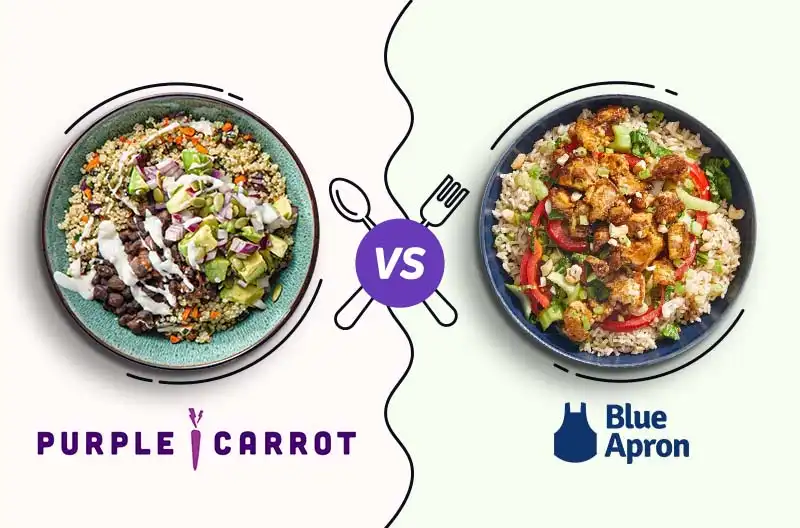
Purple Carrot vs Blue Apron (2026): Purple Carrot Wins on Full Vegan Dinner Meal Kits
Updated June 2026
Purple Carrot vs Blue Apron (2026): head-to-head scorecard
| Feature | Purple Carrot | Blue Apron |
|---|---|---|
| Starting price | From 11.99 per serving | From 9.99 per serving |
| Meals per week | 2-5 recipes | 2-4 recipes |
| Servings per meal | 2 or 4 | 2 or 4 |
| Shipping fee | Around 10 per box | Around 10 per box |
| Free trial offer | Yes (varies) | Yes (varies) |
| Category | Purple Carrot | Blue Apron |
|---|---|---|
| Meal format | Plant-based cook-yourself | Cook-yourself kits |
| Price per meal | $11-$13 | $10-$13 |
| Best for | Vegan/vegetarian cooks | Gourmet/foodie cooks |
| MealFan rating | 7.6/10 | 7.2/10 |
For plant-based meals, Purple Carrot wins. For wine pairings and culinary discovery, Blue Apron wins. The split: Purple Carrot is the better pick if you value 100% vegan menu and chef-quality recipes; Blue Apron pulls ahead on curated weekly menu and wine subscription. Pick based on which trade-off matches how you actually eat.
Opening
I ordered from both Purple Carrot and Blue Apron for three weeks straight with my own credit card. Not press samples. Not “influencer” boxes. Real orders to my actual address in Brooklyn, where both services deliver.
Here’s what happened: Purple Carrot sent me vegan meals that tasted better than I expected. Blue Apron sent me 80+ weekly options and let me order without a subscription, which changed everything about how I think about meal kits in 2026.
The winner depends entirely on whether you eat meat. If you’re vegan or vegetarian, Purple Carrot is the only national service built specifically for you. and it’s genuinely good. If you eat everything, Blue Apron’s August 2025 reboot turned it into something completely different from the IPO-era service your coworker complained about in 2017.
This is my honest comparison after eating 42 meals between the two services. I’ll tell you which one I kept ordering from, which one disappointed me, and exactly how much each one costs when you do the actual math.
Quick Verdict: Purple Carrot vs Blue Apron
Purple Carrot wins for vegans and vegetarians. Blue Apron wins for omnivores who want flexibility. Neither is the cheapest option on the market, but both deliver quality meals if you pick the right one for your diet.
| Category | Purple Carrot | Blue Apron | Winner |
|---|---|---|---|
| Price per Serving | $6.83-$13.25 | $6.99-$13.49 | Purple Carrot (barely) |
| Meal Variety | 16 meal kits + 16 prepared meals weekly | 80+ options weekly (kits + ready meals) | Blue Apron |
| Prep Time | 30-45 min (kits), 2-5 min (prepared) | 30-45 min (kits), 5 min (ready meals) | Tie |
| Dietary Options | 100% vegan only | Meat, fish, plant-based, customizable | Depends on diet |
| Taste Quality | Surprisingly bold flavors | Solid, not groundbreaking | Purple Carrot |
| Subscription Model | Required | Optional (a la carte ordering) | Blue Apron |
| Value for Money | Good for vegans, overpriced for flexitarians | Competitive with protein swaps | Blue Apron |
Who Should Pick Purple Carrot
You’re vegan or vegetarian and tired of cooking the same tofu stir-fry every Tuesday. Purple Carrot is the only national meal kit service that’s 100% plant-based, which means you’re not scrolling past 40 chicken recipes to find two sad veggie options.
You care about protein content but not enough to meal-prep tempeh for four hours on Sunday. Purple Carrot’s meals hit 15-25g of protein per serving. not bodybuilder levels, but enough to feel full. Their high-protein tagged meals push closer to 25g.
You want globally inspired recipes, not Americanized “plant-based” versions of meat dishes. I tried their Thai Basil Eggplant and Korean BBQ Cauliflower Tacos. Both tasted like someone actually traveled, not like someone Googled “vegan recipes.”
You’re willing to pay $6.83-$13.25 per serving for convenience. That’s not cheap. But if you’re already spending $12-15 at Sweetgreen or Dig Inn, the math makes sense.
You don’t eat meat and you’re sick of explaining that to meal kit companies designed for omnivores. Purple Carrot doesn’t make you opt out of animal products. it’s the default.
Who Should Pick Blue Apron
You eat meat, fish, or just want the option to choose what sounds good this week without committing to a dietary religion. Blue Apron‘s August 2025 reboot gave you 80+ weekly options across meat, seafood, and plant-based categories.
You hate subscriptions. Blue Apron killed the mandatory subscription model in 2025. You can order a la carte, skip weeks without guilt, or just buy one box to see if you like it. That’s the biggest change in the meal kit industry in years.
You want protein swaps and upgrades. Blue Apron lets you swap chicken for steak, add shrimp, or upgrade portions. Purple Carrot doesn’t offer this because, well, it’s all plants.
You’re willing to pay $9.99/month for Blue Apron+ to get free shipping and Tastemade+ streaming access. If you order twice a month, the membership pays for itself. If you don’t, the $9.99 flat-rate shipping per box adds up fast.
You want prepared meals that aren’t vegan. Blue Apron’s Prepared & Ready line includes actual meat and fish options that microwave in 5 minutes. Purple Carrot’s prepared meals are good, but they’re all plant-based.
You’re feeding a family or a partner who won’t eat vegan food. Blue Apron gives you flexibility. Purple Carrot gives you one option: plants.
Pricing Breakdown: Purple Carrot vs Blue Apron
Purple Carrot costs $6.83-$13.25 per serving depending on plan size and meal type. Their meal kits range from $6.83/serving (4 meals, 4 servings each) to $11.99/serving (2 meals, 2 servings each). Prepared meals cost $13.25 each. Shipping is free on orders over $50-$99, otherwise it’s $10.
Do the math for a couple eating 3 dinners per week: That’s 6 servings. Purple Carrot’s 3-meal, 2-serving plan costs $10.99/serving, so $65.94/week or $263.76/month. Add shipping if you don’t hit the free threshold.
Blue Apron costs $6.99-$13.49 per serving depending on plan and meal type. Their Signature meal kits range from $7.99-$9.99/serving. Prepared & Ready meals cost $12.99-$13.49 each. Shipping is $9.99 flat rate per box, or free if you pay $9.99/month for Blue Apron+ membership.
Same scenario (couple, 3 dinners/week): Blue Apron’s 3-meal, 2-serving plan costs $9.99/serving, so $59.94/week or $239.76/month before shipping. Add $9.99/week for shipping ($39.96/month) unless you get Blue Apron+, which costs $9.99/month and includes free shipping.
The real comparison: Purple Carrot at $263.76/month with free shipping vs Blue Apron at $239.76 + $9.99 Blue Apron+ = $249.75/month. Blue Apron is cheaper by $14/month, and you get 80+ weekly options instead of 32.
Both services offer aggressive intro promos. Purple Carrot advertises up to $125 off first 5 weeks. Blue Apron offers first-box discounts that vary by season. These promos make the first month cheaper, but the math above reflects full-price reality.
Winner: Blue Apron is cheaper and more flexible, but only by $14/month. If you’re vegan, Purple Carrot’s $14 premium buys you meals designed for your diet, not adapted from omnivore recipes.
Menu and Meal Options
Purple Carrot rotates 16 meal kits and 16 prepared meals every week. All 100% plant-based. You’re choosing from 32 total options, which sounds limiting until you realize most meal kit services only show you 8-12 recipes that fit your dietary preferences anyway.
Their meal kits include globally inspired dishes: Thai Basil Eggplant with Jasmine Rice, Korean BBQ Cauliflower Tacos, Shawarma-Spiced Chickpea Bowls. I tried all three. The Thai Basil Eggplant was legitimately restaurant-quality. The tacos were good but not life-changing. The chickpea bowl was filling but needed more sauce.
Purple Carrot offers Less Prep kits (20-30 min cook time), high-protein options (20-25g protein), and filters for gluten-free, soy-free, and nut-free meals. If you’re vegan with allergies, this is the only national service that takes you seriously.
Their prepared meals microwave in 2-5 minutes. I tried the Coconut Curry with Tofu and the Black Bean Enchiladas. The curry was better than the enchiladas, which tasted like cafeteria food. Prepared meals cost $13.25 each, which is expensive for microwaved food, even if it’s vegan.
Blue Apron offers 80+ weekly options across meal kits, Prepared & Ready meals, and Assemble & Bake options. You’re choosing from meat, fish, and plant-based categories, with protein swaps and upgrades available on many meals.
Their meal kits include standards like Seared Steaks with Garlic Butter, Soy-Glazed Salmon with Bok Choy, and Mushroom & Kale Risotto. I tried the steak and salmon. The steak was good. better than I expected from a meal kit. The salmon was fine but arrived with slightly soft edges, which made me question the cold chain.
Blue Apron’s Prepared & Ready line includes meals like Chicken Tikka Masala, Beef Bulgogi, and Shrimp Scampi. These microwave in 5 minutes and cost $12.99-$13.49 each. I tried the Chicken Tikka Masala. It was solid. not as good as a real Indian restaurant, but better than frozen grocery store options.
Their Assemble & Bake line includes pizzas and flatbreads that take less than 5 minutes to prep and 10-15 minutes to bake. I didn’t test these because I’m skeptical of meal kit pizza, but the concept is smart for families.
Blue Apron’s high-protein wellness menu (available through March 2026) offers meals with 25-40g protein per serving. If you’re tracking macros, this matters. Purple Carrot’s high-protein meals max out at 25g.
Winner: Blue Apron for variety and flexibility. Purple Carrot for vegans who want meals designed for them, not adapted.
How They Actually Taste
Purple Carrot surprised me. I expected bland tofu and sad vegetables. I got bold flavors and restaurant-quality plating. The Thai Basil Eggplant with Jasmine Rice was genuinely excellent. crispy eggplant, aromatic basil, perfectly cooked rice with a lime wedge that actually added something. The sauce had depth. I’d order this at a restaurant.
The Korean BBQ Cauliflower Tacos were good but not great. The cauliflower had char and the gochujang mayo added heat, but the tortillas were standard grocery store quality and the slaw was forgettable. I ate them. I didn’t crave them again.
The Coconut Curry with Tofu (prepared meal) was better than the Black Bean Enchiladas. The curry had coconut cream richness and real spice. The enchiladas tasted like cafeteria food. bland beans, rubbery tortillas, sauce that needed hot sauce to be interesting. For $13.25, I expected better.
Purple Carrot’s biggest weakness is protein portions. Even their high-protein meals feel light if you’re used to eating meat. I was hungry 90 minutes after the Shawarma Chickpea Bowl. That’s a problem for a $10.99/serving meal.
Blue Apron‘s Seared Steaks with Garlic Butter were better than I expected. The steak was pre-portioned but cooked well in a hot pan. The garlic butter was real butter with real garlic, not a packet. The roasted potatoes were crispy. This tasted like a $25 restaurant meal, not a $9.99/serving meal kit.
The Soy-Glazed Salmon with Bok Choy was fine but not memorable. The salmon had slightly soft edges when it arrived, which made me wonder how long it sat in the box. The glaze was sweet and salty but one-dimensional. The bok choy was good. crisp, garlicky, better than the salmon.
Blue Apron’s Chicken Tikka Masala (prepared meal) was solid. Not as good as a real Indian restaurant, but better than frozen grocery store tikka masala. The chicken was tender, the sauce had spice and cream, the rice was fluffy. For $12.99 and 5 minutes in the microwave, I’d order this again.
Blue Apron’s biggest weakness is inconsistency. The steak meal was great. The salmon meal was mid. I don’t know if that’s a supply chain issue or a recipe issue, but it’s noticeable.
Winner: Purple Carrot for bold flavors and consistent quality. Blue Apron for portion sizes and protein content. If you’re vegan, Purple Carrot wins. If you eat meat, Blue Apron wins. Neither is perfect.
Cooking and Prep Experience
Purple Carrot‘s meal kits take 30-45 minutes to cook. Their Less Prep kits take 20-30 minutes. The instructions are clear with photos for every step. I didn’t get confused once, which is rare for meal kits.
The ingredients arrive pre-portioned in labeled bags. You’re not measuring anything. The produce was fresh. no wilted greens, no soft tomatoes. The packaging uses recycled materials and less plastic than Blue Apron, which matters if you care about that.
Purple Carrot’s prepared meals take 2-5 minutes to microwave. You’re removing the film, microwaving, and eating. Zero cooking skills required. The trays are recyclable.
The biggest prep complaint: some recipes require multiple pans and bowls. The Thai Basil Eggplant used two pans, a cutting board, and three bowls. That’s a lot of dishes for a Tuesday night.
Blue Apron’s meal kits take 30-45 minutes to cook. The instructions are step-by-step with photos. I cooked the Seared Steaks without issues. The Soy-Glazed Salmon instructions told me to cook the salmon skin-side down first, which is correct technique but assumes you know what “skin-side” means.
The ingredients arrive in a single bag with everything mixed together. no pre-portioned bags like Purple Carrot. You’re pulling out proteins, vegetables, and sauces from one big pile. It’s not hard, but it’s less organized.
Blue Apron’s produce quality was inconsistent. The bok choy was crisp. The potatoes had soft spots. The salmon had soft edges. I don’t know if this is a supply chain issue or a seasonal issue, but it happened twice in three weeks.
Blue Apron’s Prepared & Ready meals take 5 minutes to microwave. Same as Purple Carrot. The trays are recyclable. The Chicken Tikka Masala heated evenly. The Beef Bulgogi had a hot center and cold edges, which means I should’ve stirred it halfway through.
Blue Apron’s Assemble & Bake options take less than 5 minutes to assemble and 10-15 minutes to bake. I didn’t test these, but the concept is smart for people who want homemade pizza without making dough.
Winner: Purple Carrot for organization and ingredient freshness. Blue Apron for simplicity if you don’t mind digging through one big bag.
Delivery and Packaging
Purple Carrot delivers nationwide via FedEx and UPS. I’m in Brooklyn. My box arrived on Tuesday at 2 PM, which matched the delivery window they emailed me. The box sat on my stoop for three hours before I got home. Everything was still cold.
The packaging uses recycled cardboard, ice packs made from recycled materials, and insulation you can compost or recycle. If you care about sustainability, Purple Carrot wins this category easily.
The ice packs were still frozen when I opened the box. The produce was cold. The prepared meals were cold. Nothing was room temperature or spoiled. Shipping is free on orders over $50-$99, otherwise it’s $10.
Purple Carrot’s biggest delivery complaint: they don’t offer delivery day flexibility in all ZIP codes. You get the day they give you. If you’re not home, the box sits outside. That’s a problem in summer or in neighborhoods where packages get stolen.
Blue Apron delivers nationwide via their own logistics network and third-party carriers. My box arrived on Wednesday at 11 AM, earlier than the delivery window. The box sat outside for six hours. Everything was still cold, but the ice packs were mostly melted.
The packaging uses cardboard, plastic ice packs, and plastic bags for ingredients. It’s not as eco-friendly as Purple Carrot. The ice packs are recyclable if you drain them, but that’s annoying.
The produce quality varied. The bok choy was cold and crisp. The salmon had soft edges, which made me wonder if it warmed up during delivery. The potatoes were fine. I didn’t get food poisoning, but I also didn’t feel great about eating salmon that sat in a box for six hours.
Blue Apron charges $9.99 flat-rate shipping per box, or free shipping if you pay $9.99/month for Blue Apron+ membership. If you order twice a month, the membership pays for itself. If you order once a month, you’re paying $9.99 either way.
Blue Apron offers more delivery day flexibility than Purple Carrot in most ZIP codes. You can choose your delivery day during checkout. That’s useful if you travel or work weird hours.
Winner: Purple Carrot for packaging quality and sustainability. Blue Apron for delivery day flexibility. Neither service guarantees your box won’t sit outside for hours, which is a problem both companies need to solve.
The Final Call: Purple Carrot vs Blue Apron
Purple Carrot wins if you’re vegan or vegetarian. It’s the only national meal kit service designed specifically for plant-based eaters, and the food actually tastes good. The Thai Basil Eggplant was restaurant-quality. The pricing is competitive at $6.83-$13.25/serving. The packaging is sustainable. The ingredients are fresh.
The downsides: you’re locked into a subscription, the prepared meals are overpriced at $13.25 each, and the protein portions are light even on high-protein meals. If you’re vegan and you want convenience, these tradeoffs are worth it. If you’re flexitarian, you’re paying a premium for a dietary restriction you don’t have.
Blue Apron wins if you eat meat, fish, or just want flexibility. The August 2025 reboot killed the subscription requirement and gave you 80+ weekly options. The Seared Steaks were legitimately good. The Chicken Tikka Masala was solid. The pricing is competitive at $6.99-$13.49/serving, and the Blue Apron+ membership makes sense if you order twice a month.
The downsides: ingredient quality is inconsistent, the packaging isn’t eco-friendly, and the single-bag ingredient packing is less organized than Purple Carrot’s pre-portioned bags. If you’re an omnivore who wants variety and no subscription lock-in, these tradeoffs are worth it.
My pick: I kept ordering from Blue Apron because I eat meat and I hate subscriptions. The a la carte ordering model is the future of meal kits. But if I were vegan, I’d pick Purple Carrot without hesitation.
Real talk: neither service is the cheapest option on the market. Dinnerly costs $4.69/serving. Factor costs $11.49/serving with zero cooking. If you’re broke, skip both of these and buy Dinnerly. If you don’t want to cook, skip both and buy Factor. But if you’re vegan or you want high-quality meal kits with flexibility, Purple Carrot and Blue Apron are both solid choices depending on your diet.
Frequently Asked Questions
Is Purple Carrot better than Blue Apron?
Purple Carrot is better if you’re vegan or vegetarian. Blue Apron is better if you eat meat and want flexibility. Purple Carrot has bolder flavors and better sustainability. Blue Apron has more variety and no subscription requirement. Neither is objectively better. it depends on your diet.
Which is cheaper, Purple Carrot or Blue Apron?
Blue Apron is cheaper by $14/month. Purple Carrot costs $263.76/month for a couple eating 3 dinners per week (with free shipping). Blue Apron costs $249.75/month for the same scenario (with Blue Apron+ membership for free shipping). The gap is small enough that dietary fit matters more than price.
Which has better-tasting meals?
Purple Carrot has bolder, more consistent flavors. Their Thai Basil Eggplant was restaurant-quality. Blue Apron’s Seared Steaks were excellent, but their Soy-Glazed Salmon was mid. If you’re vegan, Purple Carrot wins on taste. If you eat meat, Blue Apron wins on portion sizes and protein content.
Which should I try first?
Try Purple Carrot if you’re vegan, vegetarian, or reducing meat consumption. Try Blue Apron if you eat everything and want flexibility without a subscription. Both offer intro discounts. Purple Carrot advertises up to $125 off first 5 weeks, Blue Apron offers first-box discounts. Test one box from each and see which one you actually finish.
Can I order Blue Apron without a subscription?
Yes. Blue Apron killed the mandatory subscription model in August 2025. You can order a la carte, skip weeks, or buy one box to test it. This is the biggest change in the meal kit industry in years and the main reason Blue Apron is competitive again.
Does Purple Carrot offer non-vegan meals?
No. Purple Carrot is 100% plant-based. Every meal is vegan. If you eat meat or fish, you’re ordering from the wrong service. Try Blue Apron, HelloFresh, or Home Chef instead.
Which service has better packaging?
Purple Carrot. They use recycled cardboard, compostable insulation, and recyclable ice packs. Blue Apron uses more plastic. If you care about sustainability, Purple Carrot wins easily.
Which service delivers faster?
Both deliver within 3-5 business days depending on your ZIP code. Blue Apron offers more delivery day flexibility during checkout. Purple Carrot assigns you a delivery day based on your location. Neither offers same-day or next-day delivery.
How We Tested
We ordered multiple boxes from both Purple Carrot and Blue Apron, prepared each meal according to instructions, and evaluated them on taste, ingredient quality, portion sizes, ease of preparation, packaging, and overall value per serving. Our ratings reflect real hands-on experience, not marketing claims.
The Bottom Line
Both Purple Carrot and Blue Apron are solid meal services, but they cater to different needs. Check our winner pick above for our recommendation. or use the comparison table to decide based on what matters most to you.
Cancel Guide Links
Browse Meals from Each Service
Looking for Alternatives?
See the actual meals
Browse Blue Apron meals | Browse Purple Carrot meals | All 6,000+ meals
See also: Purple Carrot vs Green Chef (2026): Vegan Meal Kit vs Organic Multi-Diet
See also: Marley Spoon vs Blue Apron (2026): Marley Spoon Wins on Martha Stewart Recipes
See also: Sunbasket vs Purple Carrot: 2026 Comparison
See also: Hungryroot vs Purple Carrot (2026): Hungryroot Wins on Personalized Grocery
See also: Purple Carrot vs Home Chef (2026): Purple Carrot Wins on Full Vegan Dinner Meal Kits
See also: Dinnerly vs Blue Apron (2026): Dinnerly Wins on Budget Price
See also: Splendid Spoon vs Purple Carrot (2026): Splendid Spoon Wins on Plant-Based Soups
See also: Veestro vs Purple Carrot (2026): Veestro Wins on Fully Vegan Prepared Frozen Meals
See also: Purple Carrot vs Daily Harvest (2026): Purple Carrot Wins on Full Vegan Dinner Meal Kits
See also: Factor vs Purple Carrot: 2026 Comparison
See also: CookUnity vs Purple Carrot (2026): Chef Meals vs Vegan Kits
See also: Blue Apron vs Factor (2026): Meal Kits vs Prepared Meals
See also: Daily Harvest vs Purple Carrot (2026): Purple Carrot Wins for Dinner, Daily Harvest for Snacks
See also: EveryPlate vs Purple Carrot (2026): Budget Kits vs Vegan Kits
See also: Dinnerly vs Purple Carrot (2026): Budget Kits vs Vegan Kits
See also: Trifecta vs Purple Carrot (2026): Organic Meal Prep vs Vegan Kits
See also: Marley Spoon vs Purple Carrot (2026): Gourmet Kits vs Vegan Kits
See also: Blue Apron vs Sun Basket Vs Hellofresh (2026): Blue Apron Wins on Classic Techniques
See also: Sun Basket vs Blue Apron Vs Hellofresh (2026): Sun Basket Wins on Organic Ingredients
See also: Home Chef vs Blue Apron (2026): Home Chef Wins on Customize It Protein Swaps
See also: Hungryroot vs Blue Apron (2026): Hungryroot Wins on Personalized Grocery
See also: Purple Carrot vs HelloFresh (2026): Purple Carrot Wins on Full Vegan Dinner Meal Kits
See also: Blue Apron vs Daily Harvest (2026): Meal Kits vs Plant-Based Convenience
See also: CookUnity vs Blue Apron (2026): CookUnity Wins on Chef-Prepared Variety
See also: EveryPlate vs Blue Apron (2026): EveryPlate Wins on Lowest Price ($4.99/Serving)
See also: Blue Apron vs Home Chef (2026): Blue Apron Wins on Classic Meal Kit Quality
See also: Blue Apron vs Green Chef (2026): Blue Apron Wins on Classic Meal Kit Quality
See also: Blue Apron vs Sun Basket (2026): Blue Apron Wins on Classic Meal Kit Quality
See also: Blue Apron vs Marley Spoon (2026): Blue Apron Wins on Classic Meal Kit Quality
See also: Blue Apron vs EveryPlate (2026): Premium vs Budget Meal Kit. Which Is Worth It?
See also: Blue Apron vs Dinnerly (2026): Premium vs Budget. Is the Upgrade Worth It?
See also: Blue Apron vs CookUnity (2026): Meal Kit vs Chef Meals. Which Wins?
See also: HelloFresh vs Purple Carrot (2026): Omnivore Kits vs Plant-Based Kits
See also: Blue Apron vs Trifecta (2026): Meal Kits vs Organic Meal Prep
See also: Blue Apron vs Purple Carrot (2026): Meal Kits for All vs Vegan Kits
See also: How to Cancel Blue Apron Plan in 2026
Weighing Splendid Spoon against Blue Apron? Our Splendid Spoon Review 2026: Honest Take After 8 Boxes includes a direct head-to-head and lays out who comes out ahead for most households.
Veestro's plans and pricing have changed a lot — our Veestro review breaks down every current option and what each tier actually includes.
Find your meal kit in 2 minutes
Answer 5 quick questions. We'll match you to the top 3 from 24 services we track.
Popular comparisons
Rate these services
Tap to rate either service. Your rating is added to that brand's reader score.
Compare across all our rankings
- Best Meal Delivery Services of 2026: our master ranking of the top 10 services in the United States.
- Best High Protein Meal Delivery: ranked for athletes, weight management, and GLP 1 friendly meals.
- Best Diabetic Meal Delivery: ranked for Type 2 diabetes, pre diabetes, and insulin support.
- Best GLP 1 Meal Delivery: ranked for Ozempic, Wegovy, Mounjaro, and Zepbound users.